London School of Economics and Political Science · British Academy Ideas Festival 2026
Street Vendors: Smarter Choices, Tougher Lives Than You'd Think
Swati Dhingra · Muskan Jain · Lachi Singh
Global Context
A large number of people work as street vendors across the world
Depending on where you focus, street vending makes up anywhere from 1.8% to 8% of employment in developing countries.
Source: WIEGO Statistical Brief, July 2024
Zooming into India
Street vending is essential urban work, largely without legal protection.
-
—
Street vendors sell fresh produce, cooked food and everyday goods in public spaces they have no legal right to occupy
-
—
They serve millions of households daily, providing convenience and cheaper alternatives
-
—
Most lack basic infrastructure, stable tenure, and awareness of the rights the law affords them
-
—
Our research focuses on Patna, Bihar, to understand how this sector works and what it costs those within it
Zooming into Patna, Bihar
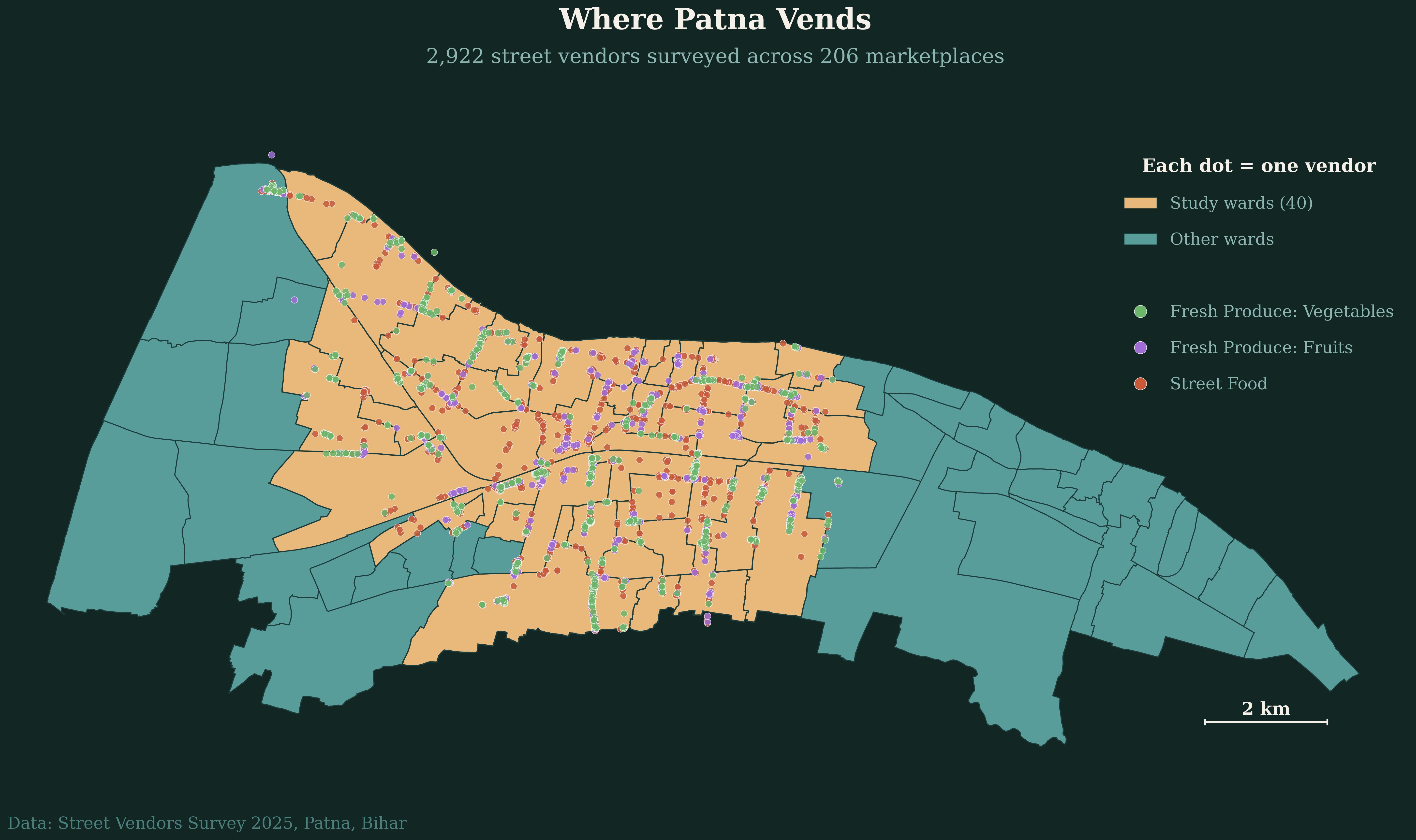
Patna is home to an estimated 30,000 street vendors.
-
—
Capital city of Bihar — India's third most populous state
-
—
Patna Municipal Corporation area has a population of 2.5 million across 75 wards
-
—
Our survey covers the 40 wards with the highest vendor concentration, highlighted on the map
Behind the data
Let's meet the people who make it work.
Meena, Raju and Suresh have been working in the same market for over a decade.
Meena
Vegetable Seller · 58 years
Raju
Street Food Stall · 35 years
Suresh
Fruit Seller · 40 years
Our data says 99% of street vendors have never changed their marketplace.
A day in the life
Let's start with one day in Meena's life.
Meena sells vegetables from the ground under a tarpaulin. She has worked the same spot for over a decade: buying at dawn, selling through the day, and discounting what remains by dusk.
Meena
Vegetable Seller · 58 years
Meena, Raju and Suresh are fictional characters created to illustrate findings from real survey data.
Meena is up at 4:30am. The house is still dark.
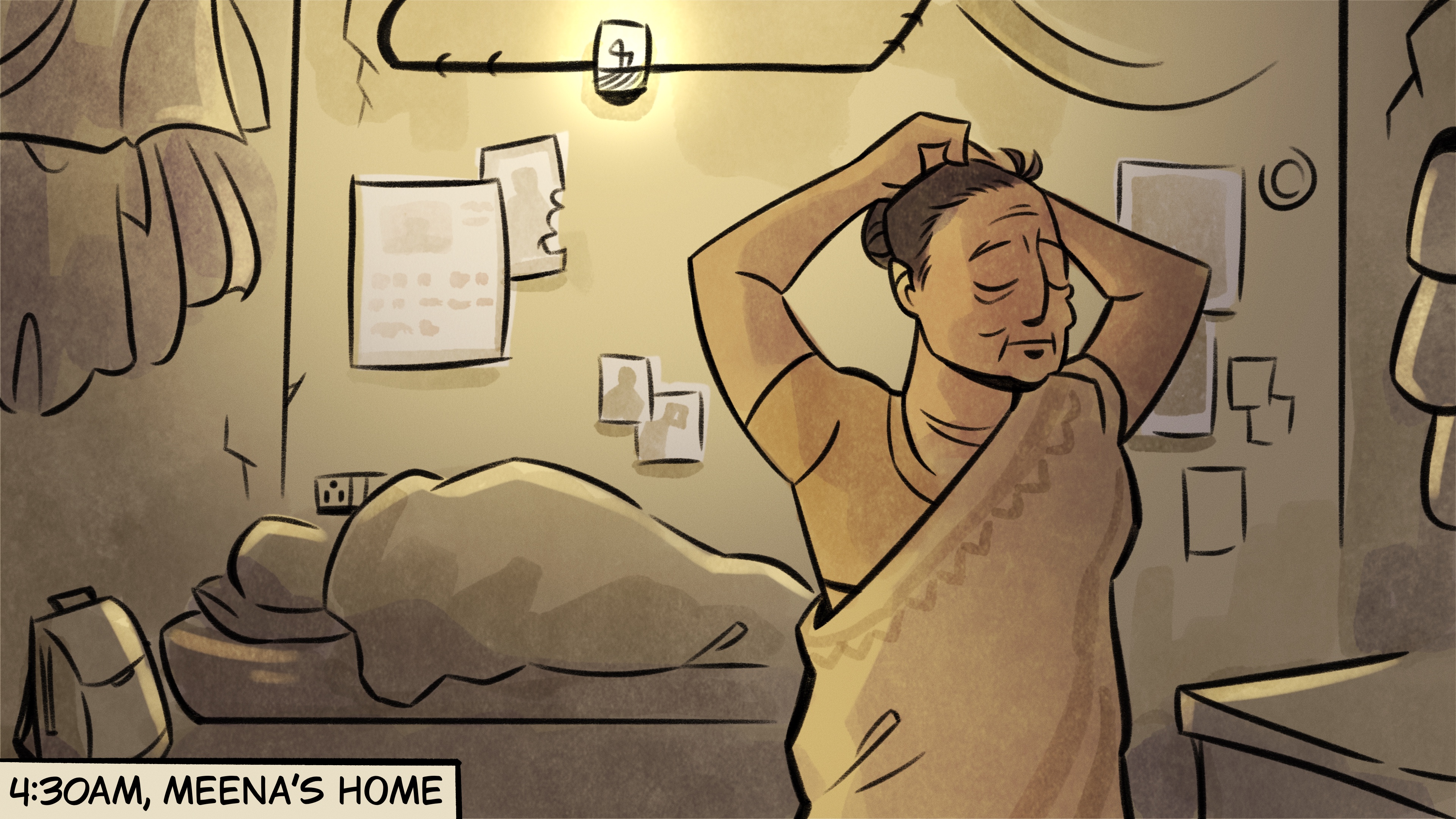
From our surveyVendors set their own hours and keep them: 95% work seven days a week, averaging over nine hours a day, and that's excluding preparation time and the trip to the wholesale market.
She is at the wholesale market before the city wakes, loading vegetables she will carry to her spot on the ground.
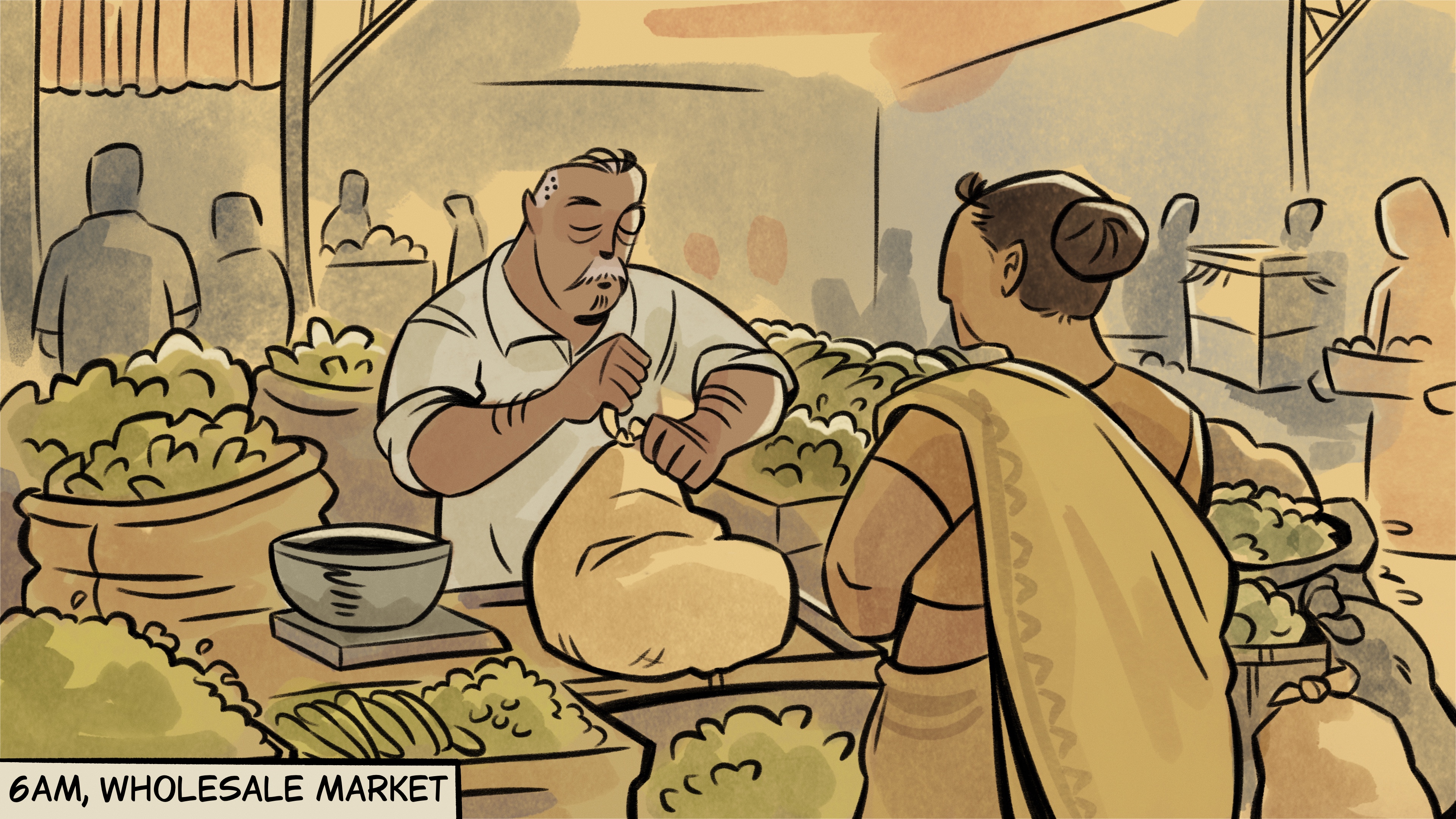
From our surveyEvery morning is a procurement run. Vendors hand-pick produce, judge quality and negotiate prices, before the city wakes. 75% buy directly from wholesale markets, and most do the buying themselves.
She sits behind her produce for nine hours, no chair, no proper shade, no permanent shelter.
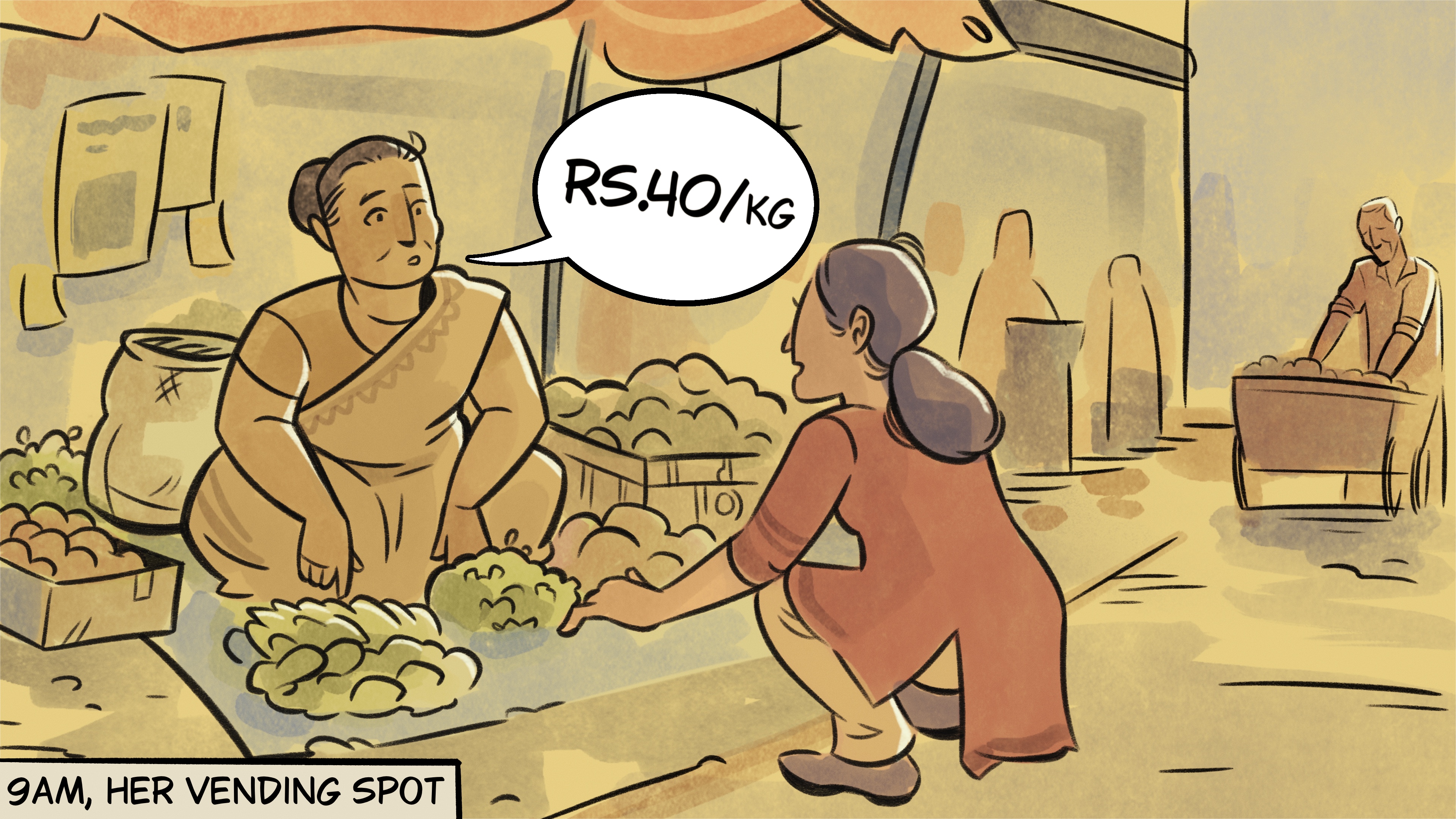
From our surveyProduce vendors price with a cost-plus rule: a fixed margin on that morning's wholesale cost, applied fast and adjusted as stock and demand shift through the day.
Rain arrives without warning. She covers what she can.
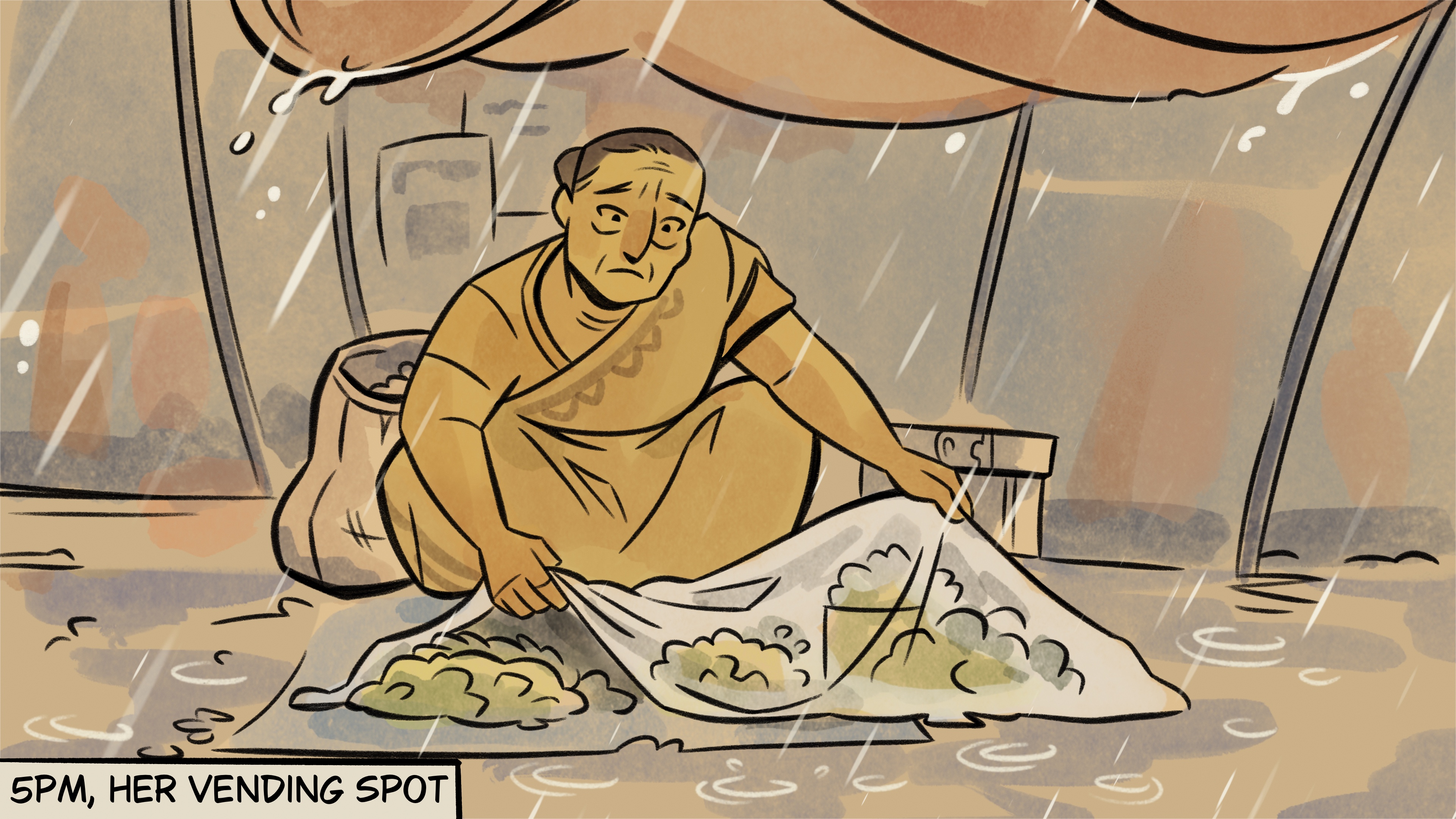
No infrastructureWith no weather protection at most spots, vendors do what they can when the weather turns: 85% use plastic or cloth, others move stock to shade or pack up earlier in the day, but rain still means damaged produce and lost hours. And stopping isn't an option: barely 1 in 200 can afford not to sell at all on bad weather days.
Whatever hasn't sold by dusk gets discounted. Wasted stock is a day's earnings gone.
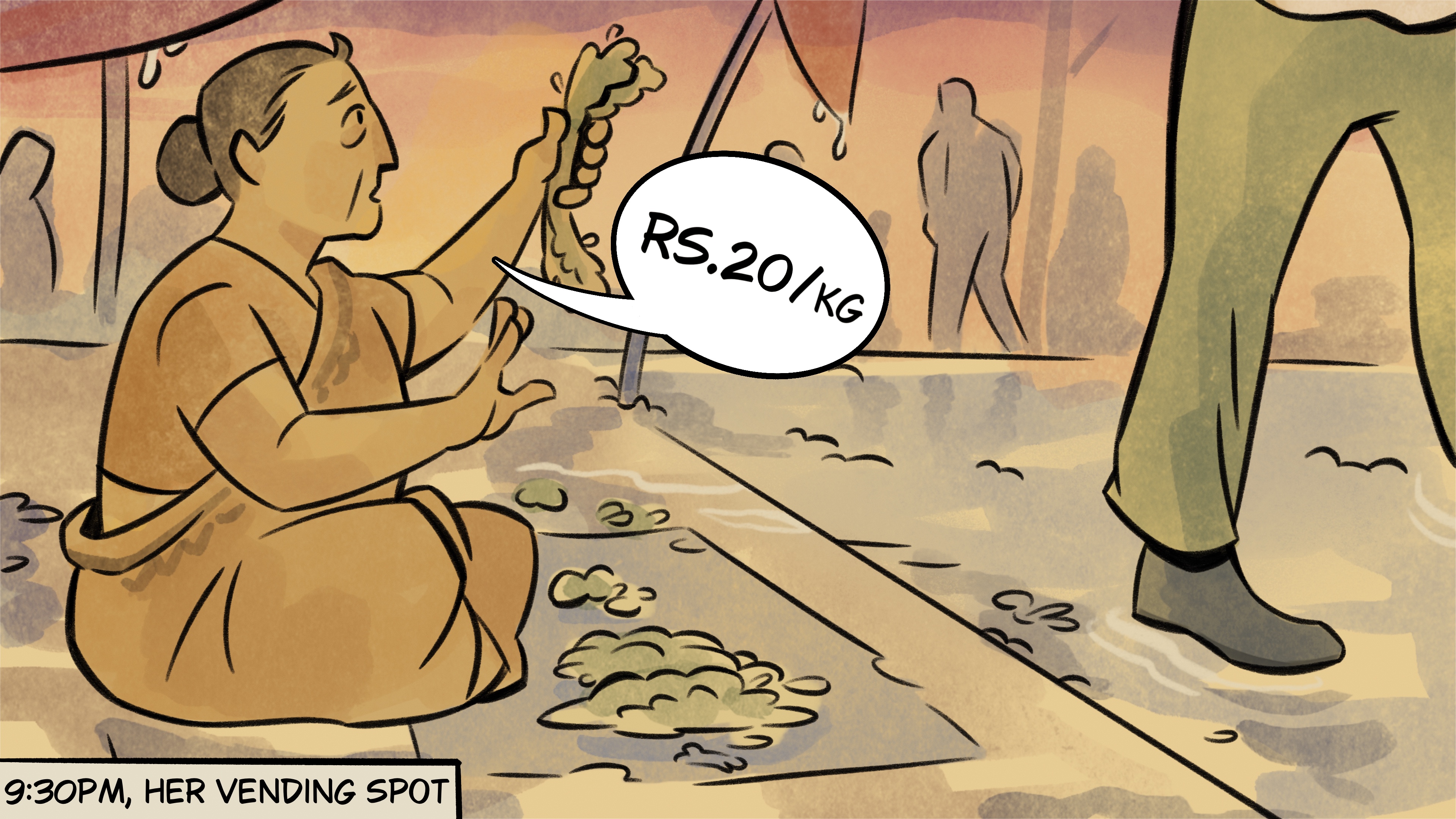
From our surveyBy dusk, unsold produce is marked down to recover what it can before it spoils. A deliberate loss-cutting decision, but the loss is still real. 58% of produce vendors do this regularly. The Rs 40 of the morning becomes Rs 20 at dusk.
A day in the life
Now, one day in Raju's life.
Raju sells street food from a coal-roasting cart, with his wife working alongside him. He has been at the same spot for years, and has been moved on from it more times than he can count.
Raju
Street Food Stall · 35 years
Meena, Raju and Suresh are fictional characters created to illustrate findings from real survey data.
The workday starts at home, before the cart is out. Raju and his wife cook together in the early morning.
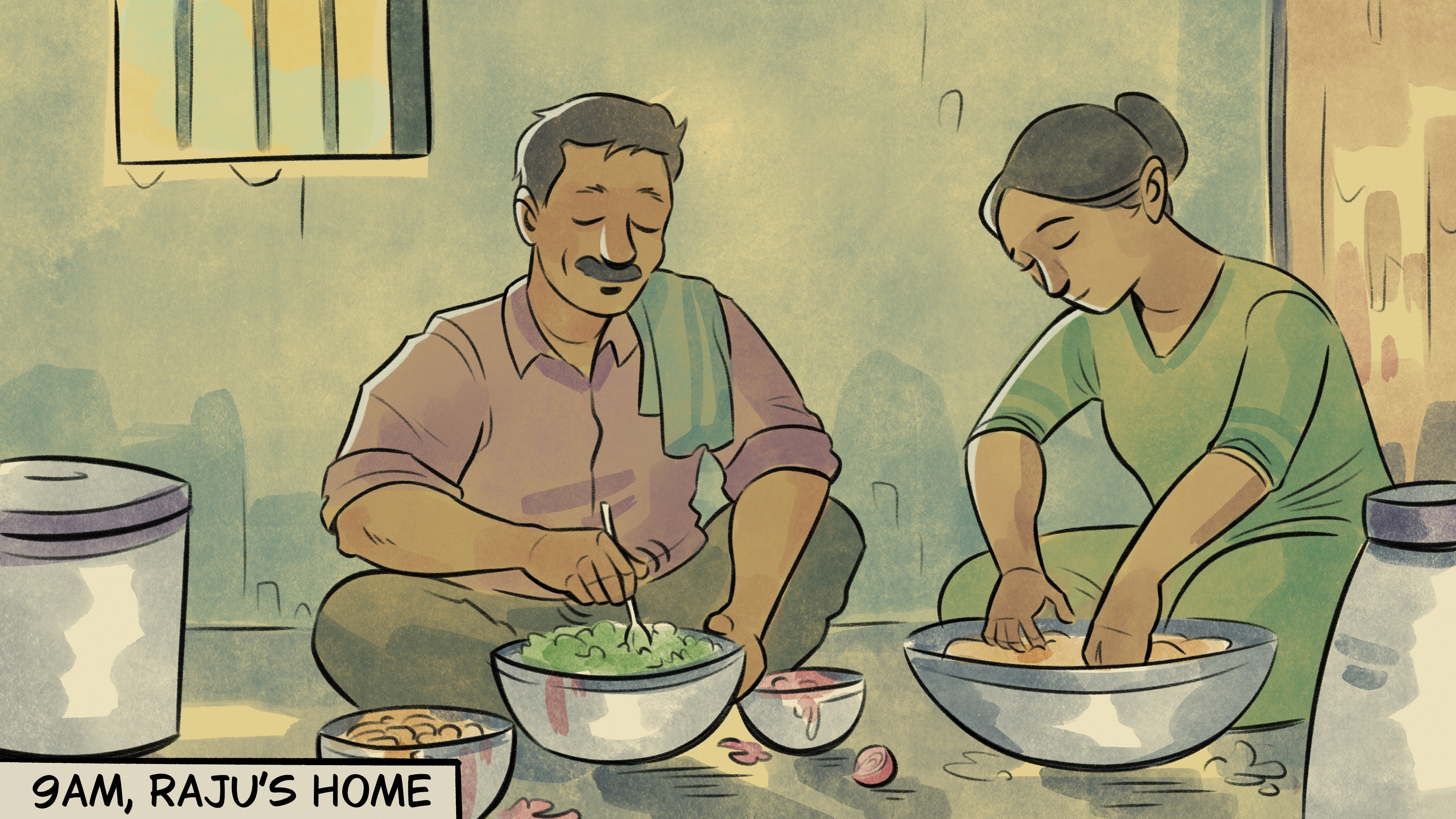
Before the stall opensFor street food vendors, the stall is the last stage of a much longer day. Food is prepared at home from early morning, the household is the kitchen and the family the workforce, a small production line running before the cart ever moves.
He wheels the cart to his spot on the road. The same spot, every day, for years.
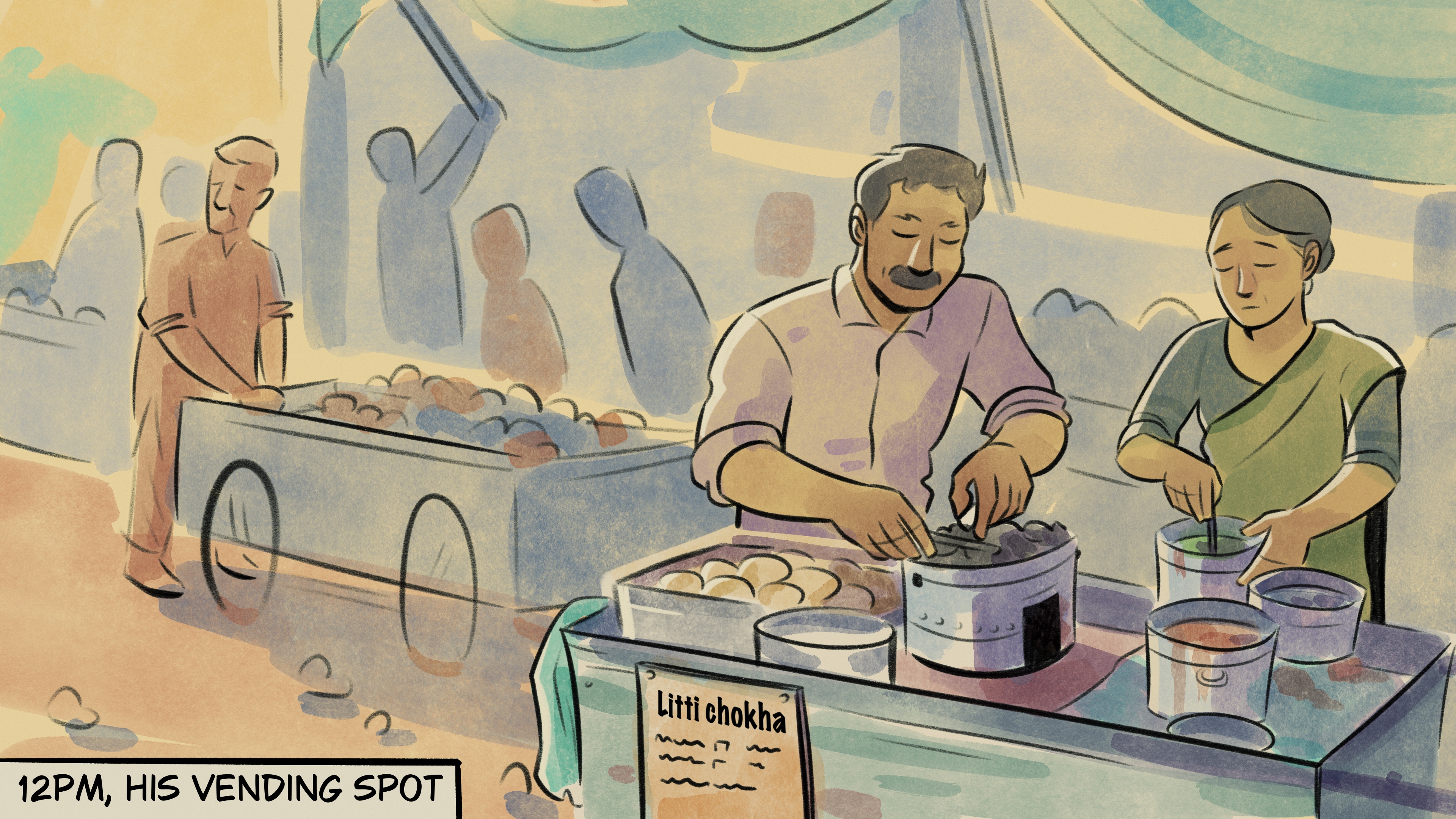
From our survey85% of vendors operate a stall or cart they built and maintain themselves, their own working capital. And nearly 9 in 10 already take digital payments: informal does not mean behind the times.
The evening rush is the best part of the day. He and his wife barely pause.
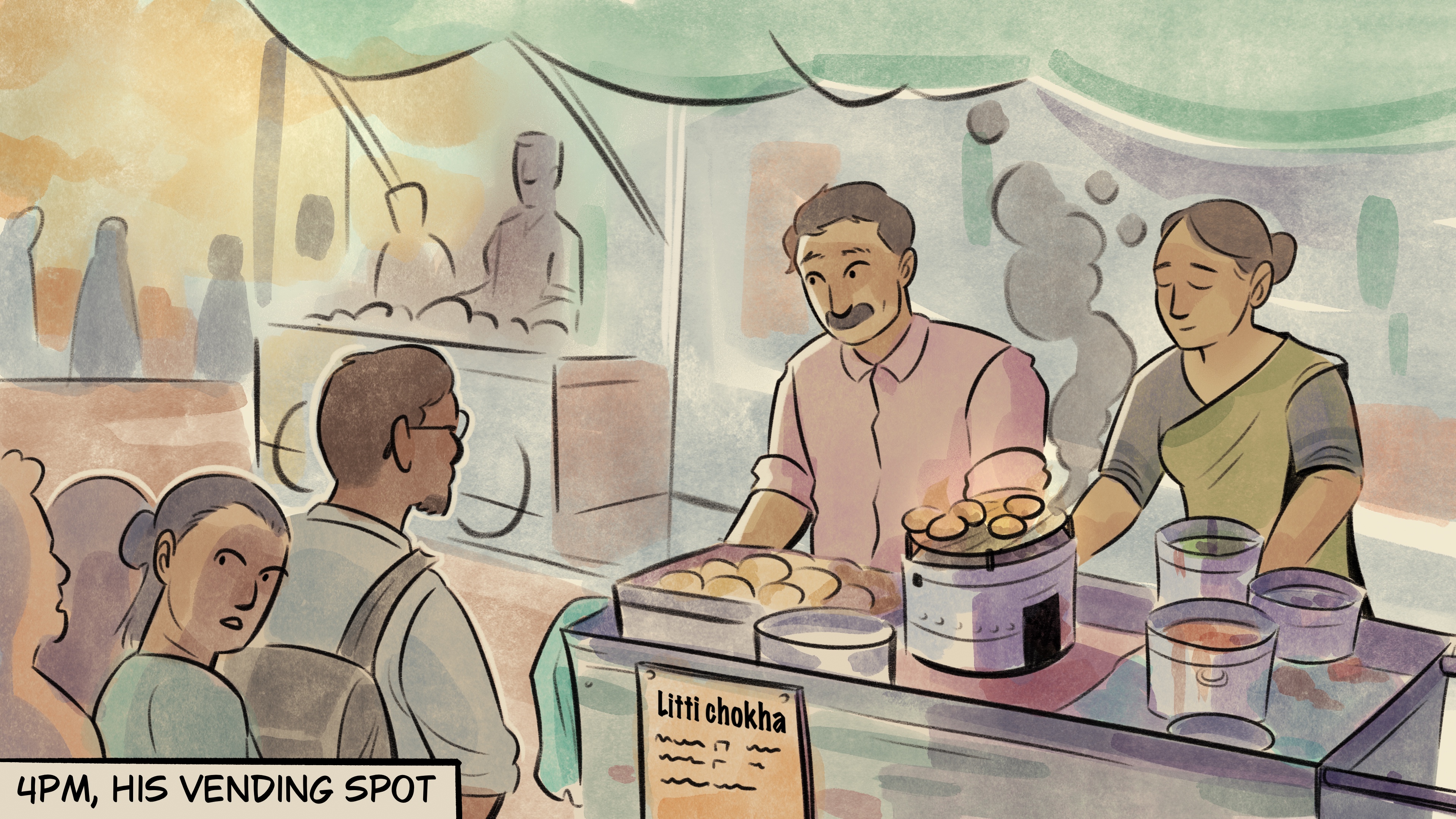
From our surveyThe rush is the day’s payoff. An average street-food stall makes about Rs 530 (~£4.2) in profit a day, shared across everyone whose labour ran it.
A municipal van arrives. Raju pushes the cart away mid-service. This has happened more times than he can count.
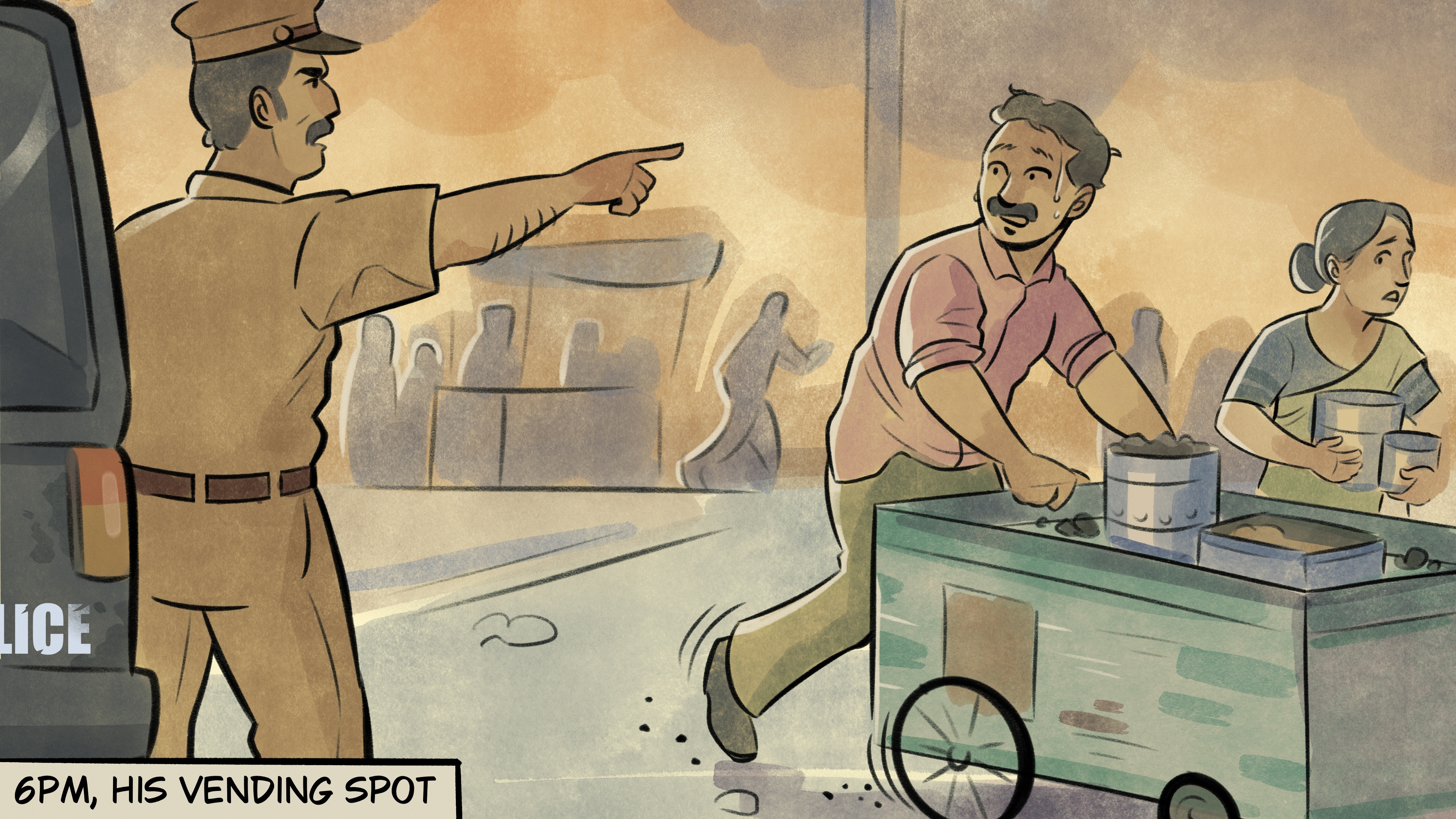
From our surveyIn the six months before the survey, 33% of vendors had goods confiscated or were evicted, and 42% faced harassment by police or officials. Very few, just 1.3%, know about the 2014 law passed to protect them.
The street is quiet now. He sits beside the packed cart, worn out by more than just the work.
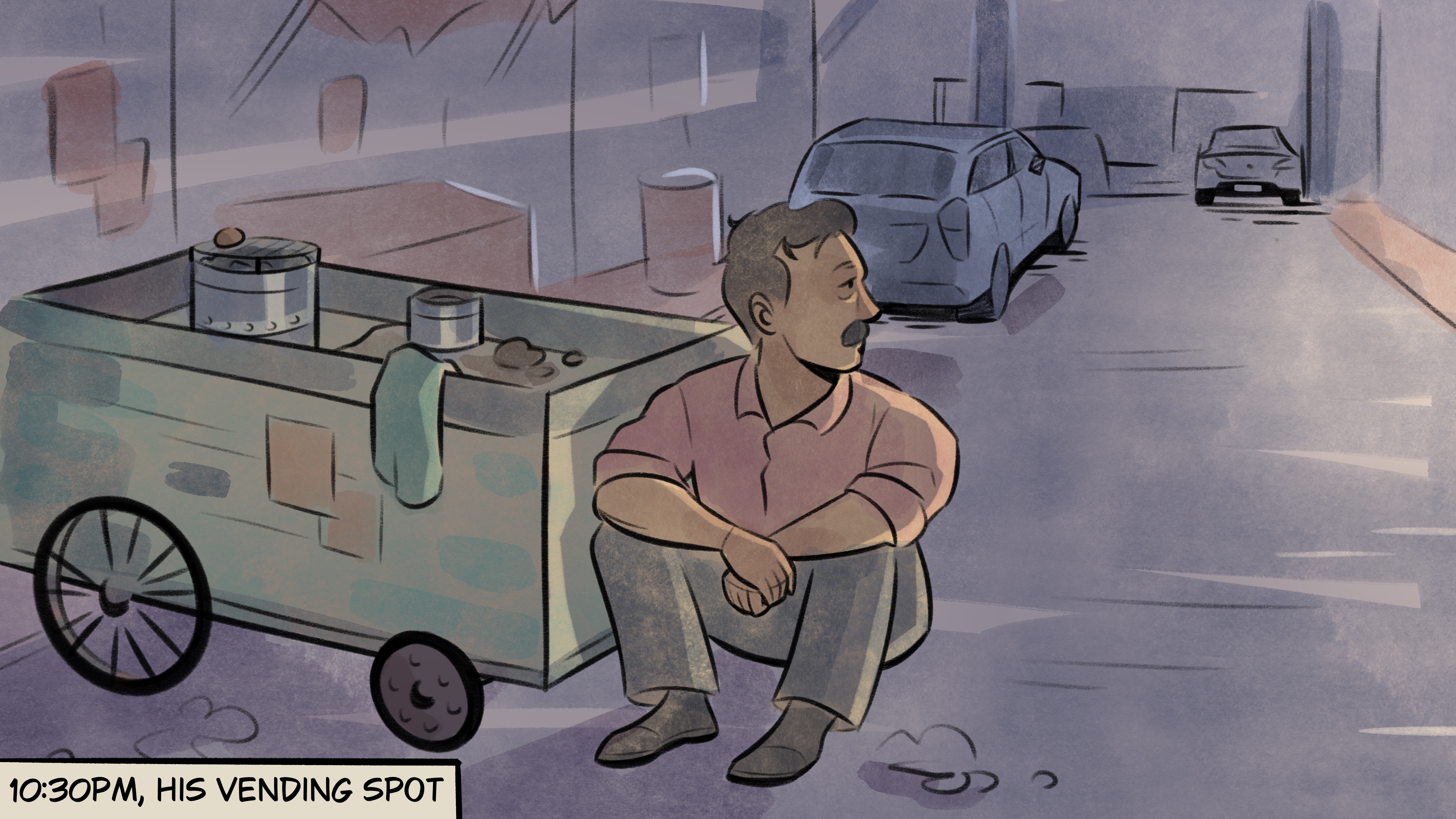
From our surveyOver 40% of vendors show signs of moderate to high psychological distress. No days off, no sick leave, no safety net, and long hours day after day.
A day in the life
And one day in Suresh's life.
Suresh sells fruit from a cart along the main road. His 15 year old son Arun joins him after school each day. His supplier has known him for over a decade. So has this corner of the street.
Suresh
Fruit Seller · 40 years
Meena, Raju and Suresh are fictional characters created to illustrate findings from real survey data.
Suresh is up at 4am. His son Arun is still asleep.
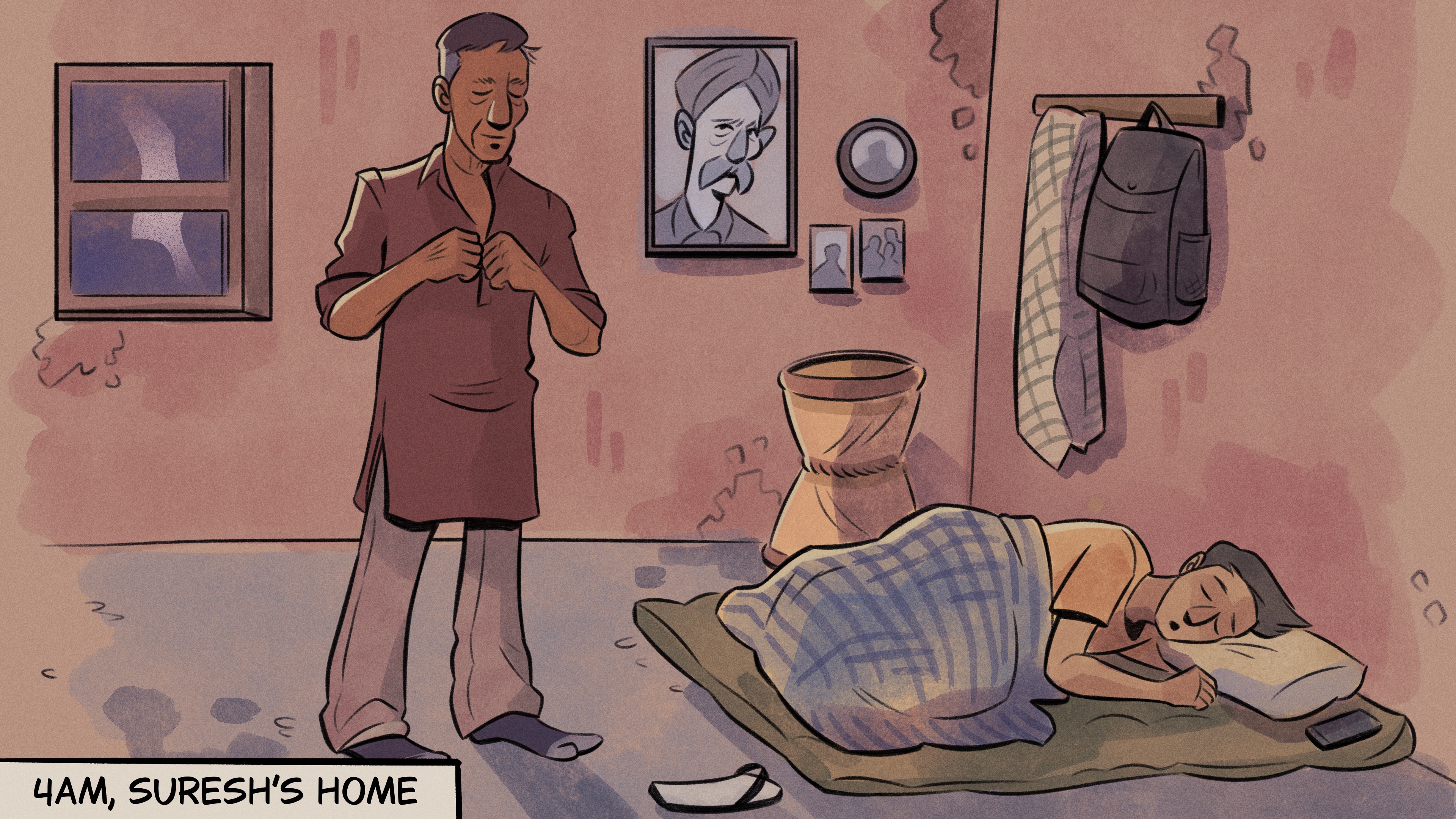
From our surveyAbout a third of vendors entered the street vending sector by joining an already established family business. Over half in our sample have been vending for more than 10 years. Vending is not transitional work but life-long occupation passed through generations.
His supplier recognises him before he speaks. They have been doing this for over a decade.
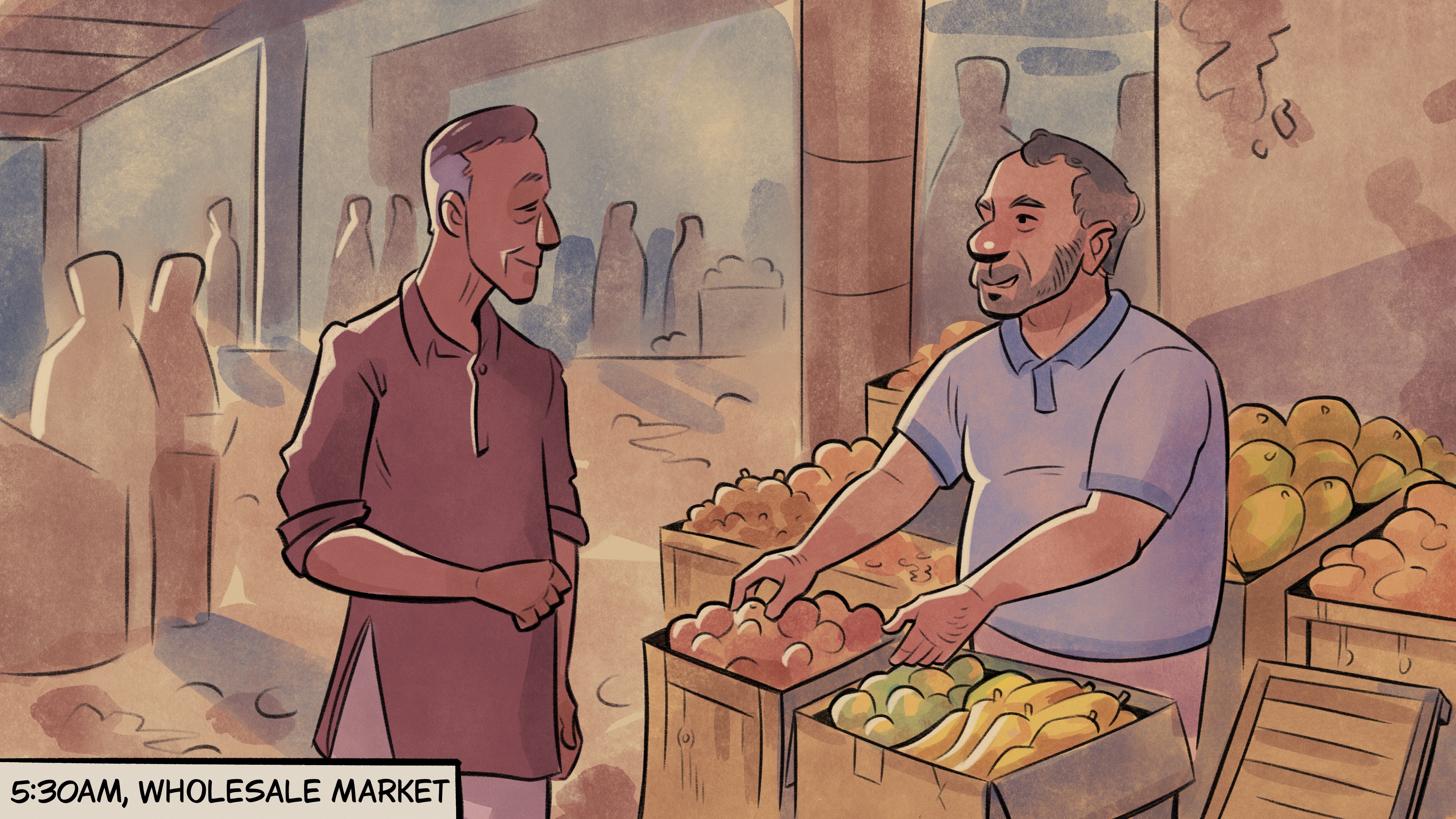
From our survey54% of vendors buy from the same supplier year after year. With no written or formal contracts in the sector, that relationship does the work of one and helps secure stock, steady prices and often informal credit. Trust is the infrastructure.
He sets out his fruit and opens for the day. The same corner, again.
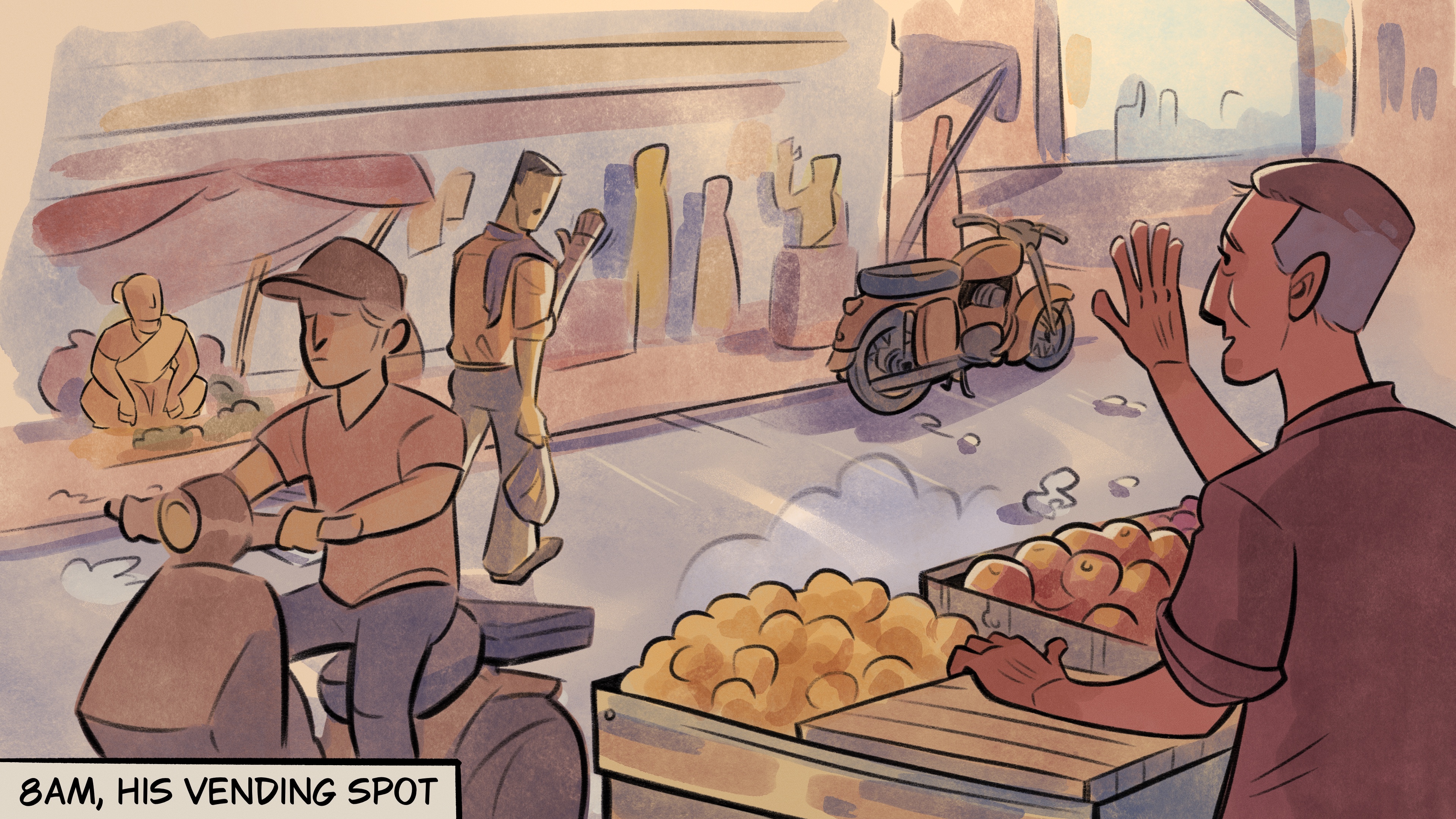
From our surveyLocation is a vendor's most valuable asset. 84% of vendors set up on main roads, positioned where commuter footfall is highest. Most have occupied the same few square metres of public space for over a decade.
Arun comes straight from school. No pause between the two halves of his day.
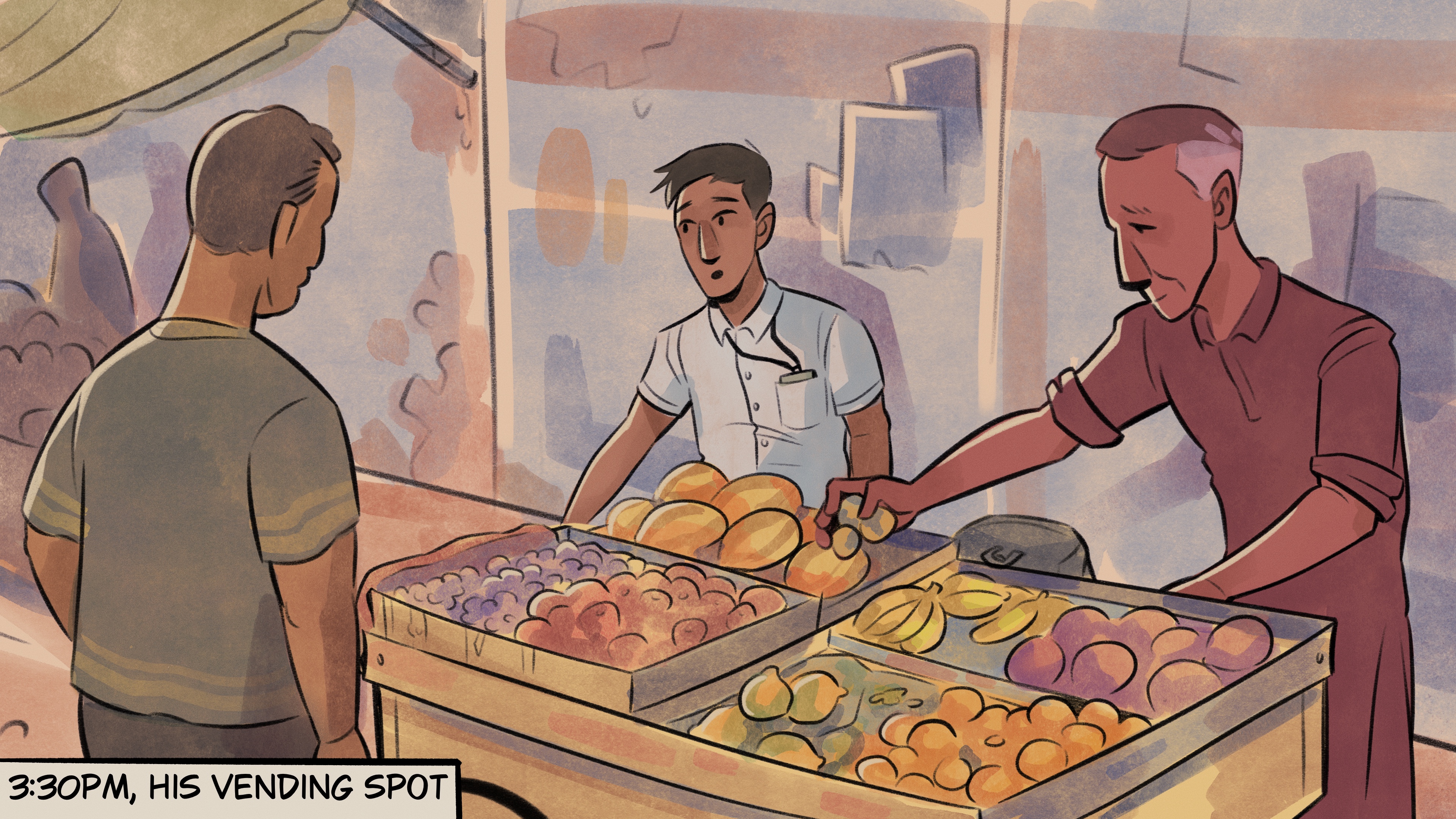
From our survey90% of vendors with helpers rely entirely on unpaid family labour. For many, vending is less a choice than a path set by the family they were born into.
They pack down together at dusk. Tomorrow it starts again at 4am.
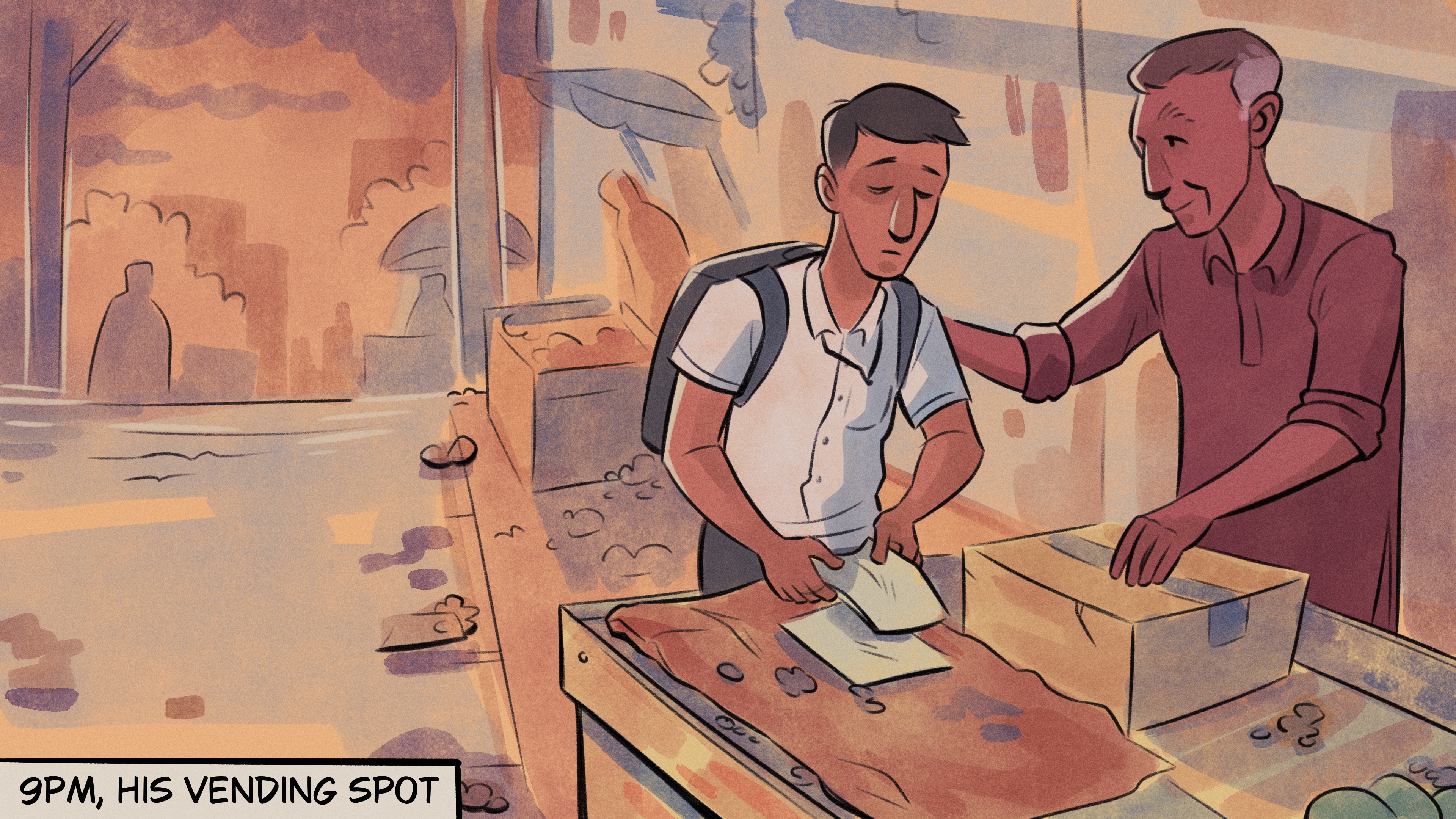
From our surveyFor about half of vendors, the reason they began was simple: no other work could be found. And street vending is rarely a stepping stone — it is, for most, a permanent livelihood.
What did we learn?
Smarter than assumed.
More precarious than acknowledged.
-
—
Most vendors work long hours, all seven days of the week
-
—
Their livelihoods are built on years of accumulated relationships — with suppliers, customers and neighbouring vendors
-
—
Without shelter or storage infrastructure, weather and spoilage directly cut into their earnings
-
—
Evictions are routine and unpredictable, disrupting income without warning or compensation
-
—
The work is passed down through families — for many, there was no other path into this occupation
Policy directions
What would help?
Design vending zones that are spatially close to existing markets — vendors resist relocation above all else
Provide weather infrastructure at vending spots — covered stalls would directly protect earnings
Enforce and disseminate the Street Vendors Act 2014 — only 1.3% of vendors currently know it exists
Formalise supplier relationships — simple contracts could replace the informal trust networks vendors currently depend on
Primary Survey · Patna, Bihar · 2025
Now let's see some real images from the field.
From the field · Patna, Bihar · 2025
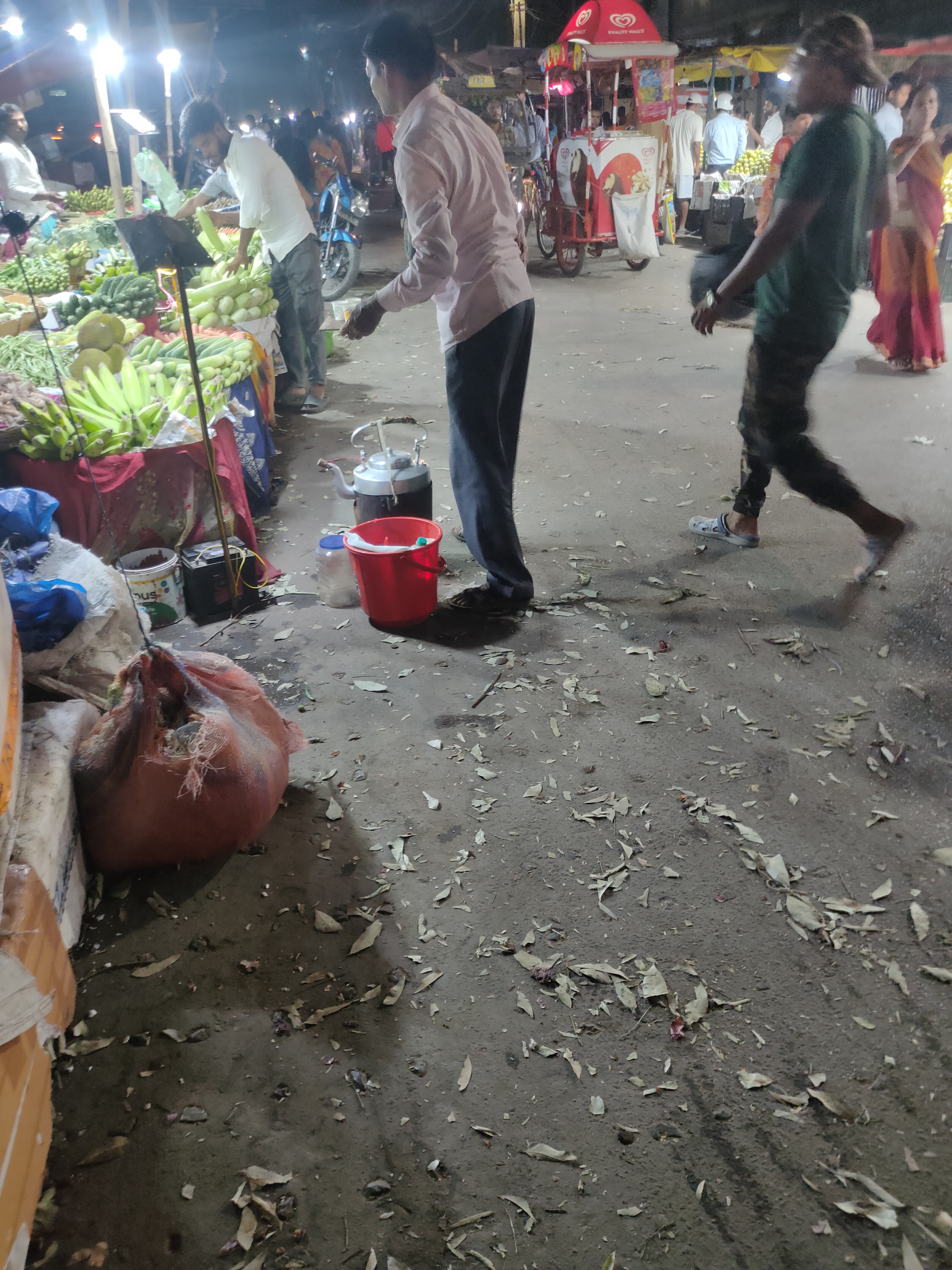
An evening street market in Patna. Vegetable stalls, food carts and pedestrian traffic occupy the same road — a typical scene in the 206 marketplaces we surveyed, and the kind of corner Suresh works every day.
From the field · Patna, Bihar · 2025
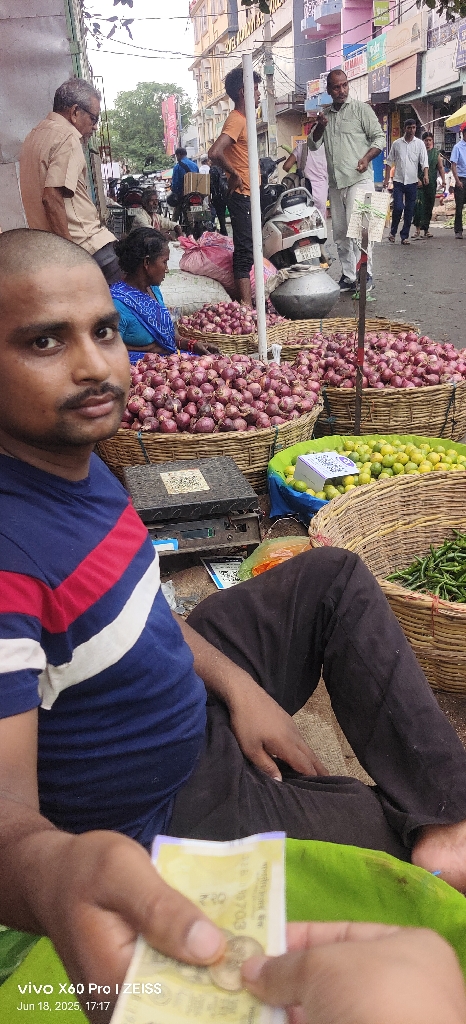
A vegetable vendor seated on the ground between baskets of onions, limes and greens, completing a cash transaction. Most vegetable vendors in our survey, like Meena, operate without a stall or any fixed structure.
From the field · Patna, Bihar · 2025
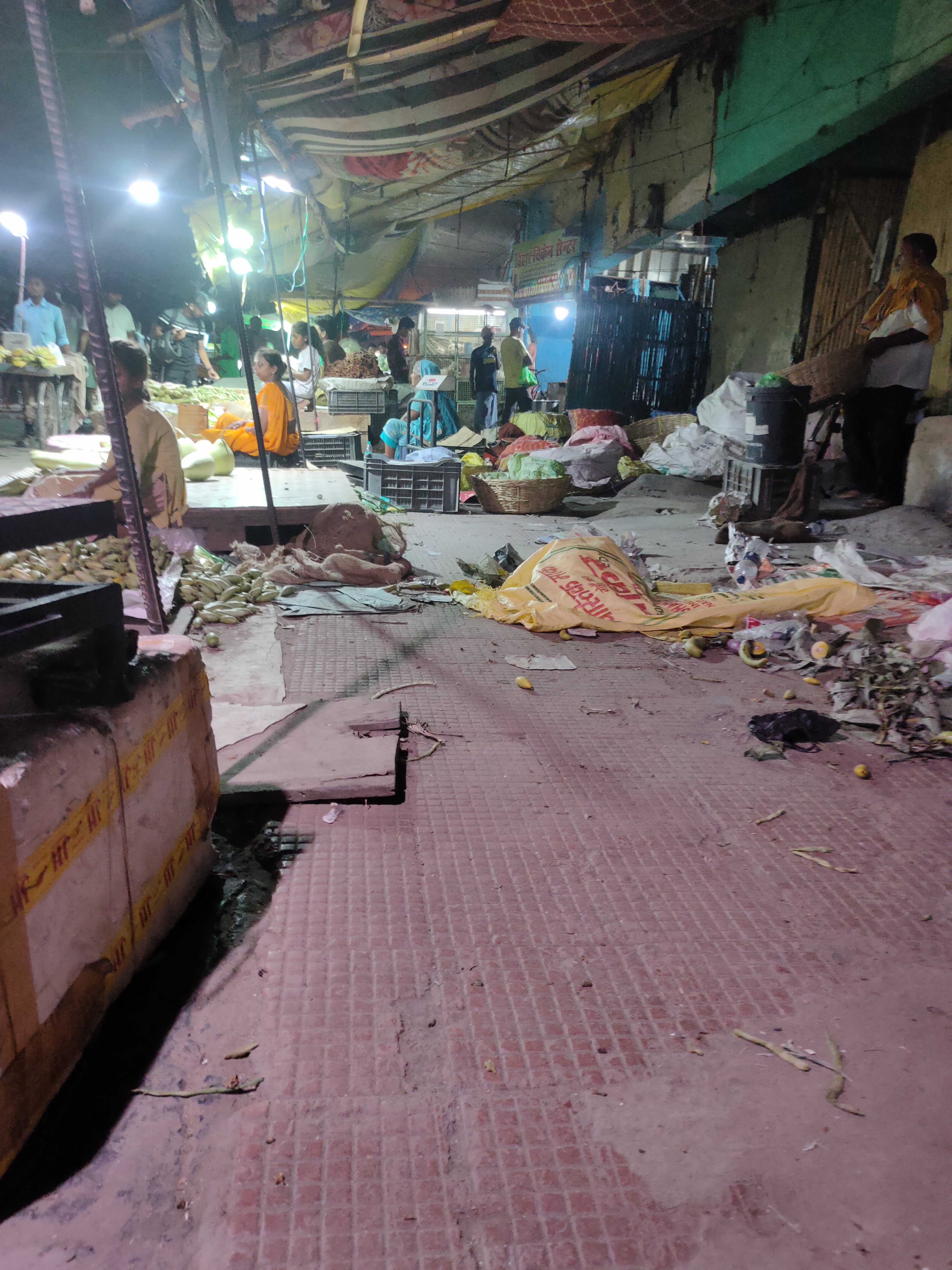
A marketplace at night. Vendors work under tarpaulins and bare bulbs on public ground they have no legal right to occupy.
From the field · Patna, Bihar · 2025
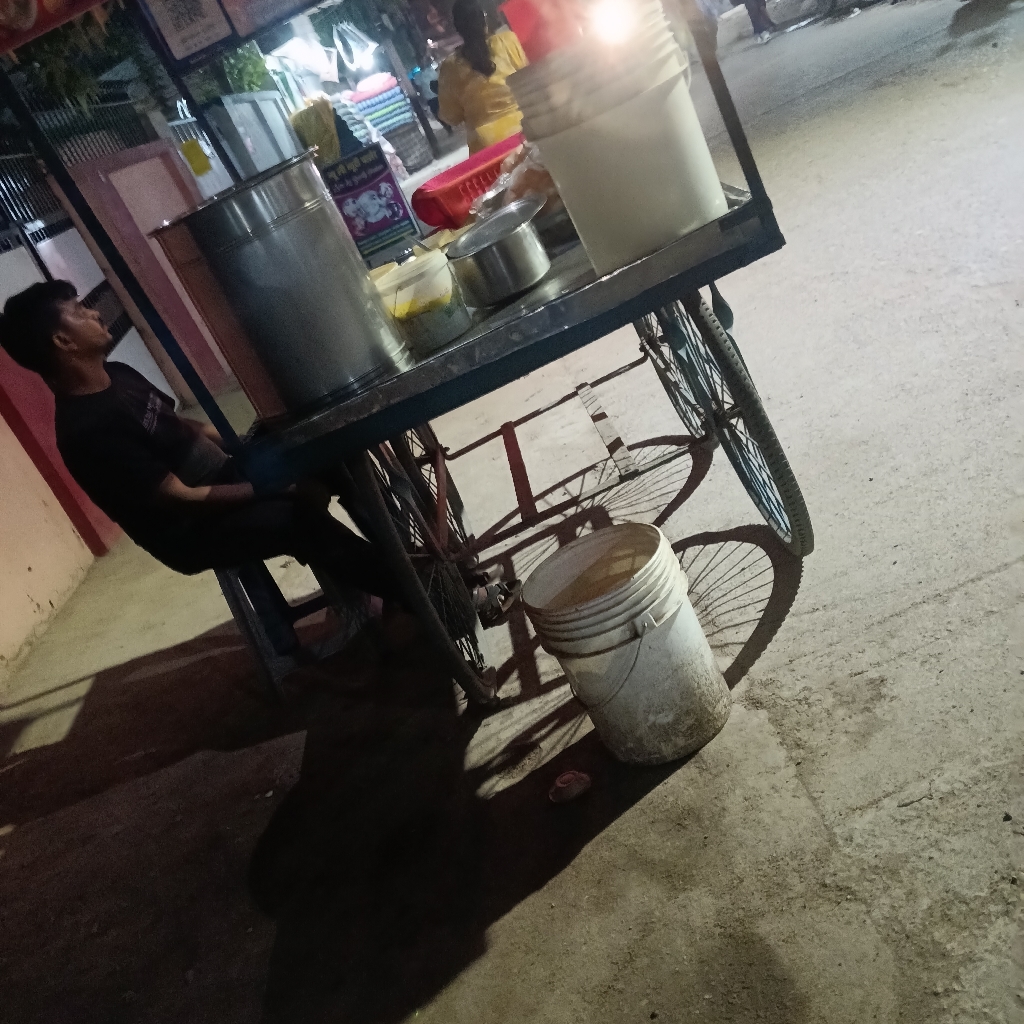
A street food vendor's cart at night, with a glass display case and metal containers. This is what Raju's cart looks like in real life.
From the field · Patna, Bihar · 2025
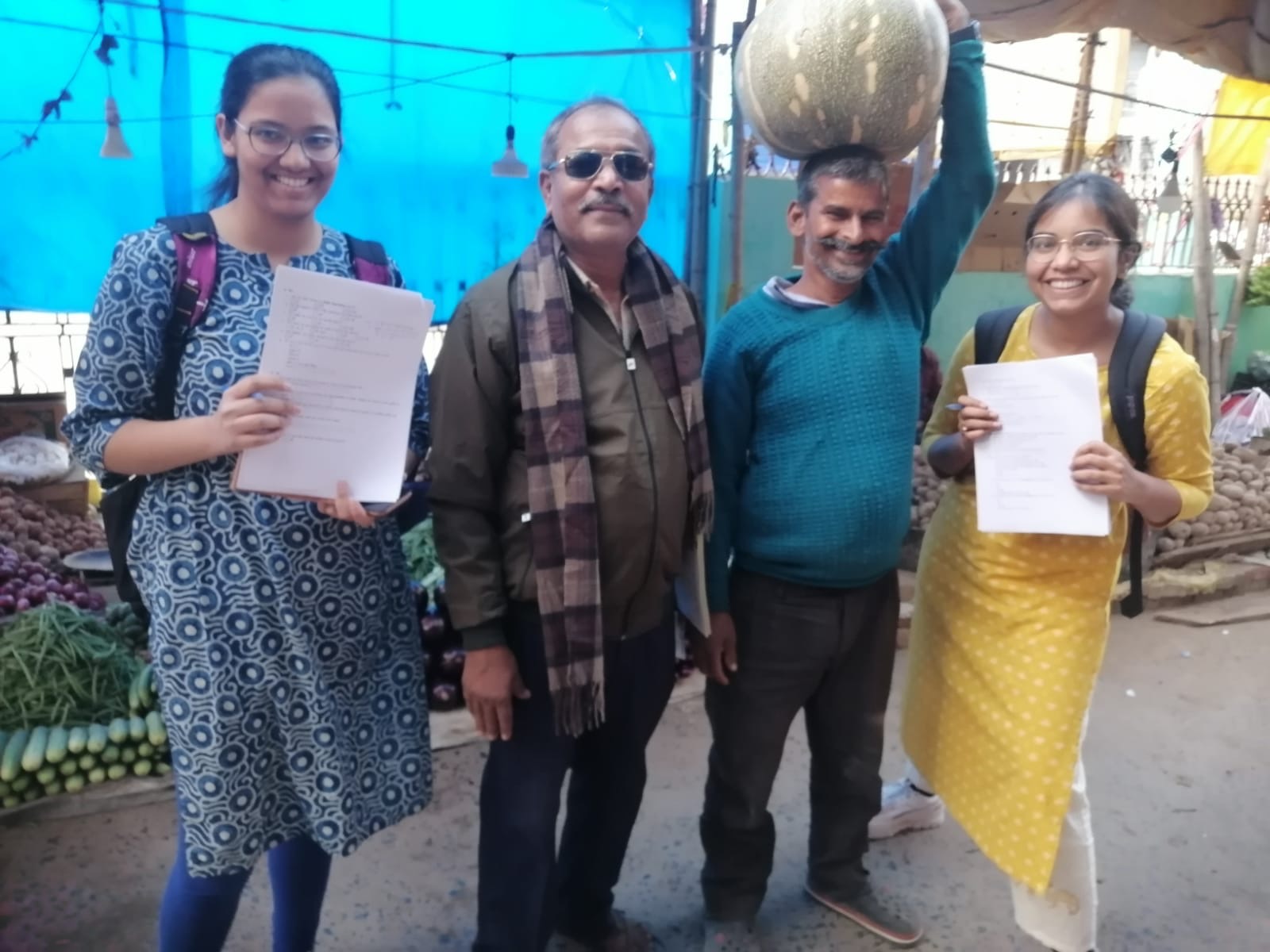
A moment during fieldwork. Researchers with a vendor at one of the 206 marketplaces surveyed across Patna.
Credits
Researchers
Swati Dhingra
sdhingra.com
Muskan Jain
jainmuskan.com
Lachi Singh
lachisingh.com
Illustrations
Nikkhil Nair
@vander.tenn
Survey Partner
Sunai Consultancy
Field Work Approved By
Patna Municipal Corporation
Funded By
International Growth Centre (IGC) · HER Grant at STICERD, LSE · British Academy / Leverhulme Small Research Grant Scheme

Leave your feedback
Scan to share your thoughts
about what you saw today.